Short answer
Queensland requires a fire hydrant system where a building's total floor area exceeds 500 m² and a fire station is within 50 km by road (NCC clause E1D2). AS 2419.1:2021 then requires each feed hydrant within 20 m of a fire truck hardstand, the whole building within 70 m of that truck, and 10 L/s per required outlet.
In this guide
- When does a building need a fire hydrant system?
- Coverage: how far hydrants have to reach
- Flow and pressure
- Fire brigade boosters
- Fire pumps
- Queensland Fire and Rescue: referral and documentation
- Testing and maintenance under AS 1851 and Queensland law
- Who can design, install and certify hydrant systems?
- Checklist for a compliant hydrant system
- Frequently asked questions
- Sources
This guide is for building owners, builders and certifiers working on commercial buildings in Toowoomba and across Queensland. It covers when hydrants are required, how coverage is measured under the 2021 edition of AS 2419.1, flow and pressure, boosters and pumps, Queensland Fire and Rescue's requirements, Toowoomba's water network rules, and maintenance under AS 1851. Where a figure comes from a secondary source rather than the standard itself, we say so. AS 2419.1 is a paid standard, and your hydraulic designer should work from the full text.
When does a building need a fire hydrant system?
Under NCC 2022 Volume One, clause E1D2, a fire hydrant system is required for a building with a total floor area of more than 500 m², where a fire brigade station with suitable firefighting equipment is within 50 km by road. The system must be designed and installed to AS 2419.1:2021, the edition referenced by NCC 2022. Ask your certifier which edition applies to your approval if the application straddles the changeover.
Hose reels are a separate requirement under clause E1D3 and are installed to AS 2441. Fire hydrants are classed as special fire services in Queensland, so building work that includes them is generally referred to Queensland Fire and Rescue (QFR) for advice. QFR is the operational arm of the Queensland Fire Department, which replaced QFES.
Coverage: how far hydrants have to reach
AS 2419.1:2021 changed how coverage is measured. The 2005 edition used a hose length plus a 10 m hose stream. The 2021 edition sets maximum distances directly:
| Hydrant type | AS 2419.1:2021 coverage rule | 2005 method, for comparison |
|---|---|---|
| External feed hydrant | No more than 20 m from a fire brigade pumping appliance on a hardstand, with every part it protects no more than 70 m from that appliance | 60 m of hose plus a 10 m stream |
| Internal hydrant | Every part of the floor no more than 40 m from the hydrant, or 45 m where NCC deemed-to-satisfy travel distances are met | 30 m of hose plus a 10 m stream |
| External attack hydrant | Can be up to 100 m from the hardstand, under specific conditions | No direct equivalent |
Distances are measured as hose laid on the ground along the normal path of travel, not in a straight line. Industry summaries of the 2021 edition also note two limits. External hydrants alone can cover up to four levels above ground and one below. Where internal hydrants are installed, external hydrants cover up to two levels above and one below. The 2021 edition also no longer covers buildings over 135 m in effective height or very large Class 7b and 8 buildings, which need a fire engineering approach.
Using a street hydrant
Small buildings can sometimes meet the hydrant requirement with a single council street hydrant. QFR treats a street hydrant as an external feed hydrant. The street hydrant must be within 20 m of the fire truck, and all parts of the building within 70 m of hose laid from the truck. For the calculation, neither the truck nor the street hydrant can be closer than 10 m to the building. The hydrant must be at least 10 m from high-voltage electrical equipment and LPG or combustible storage. A street hydrant can't be counted if the design includes a fire brigade booster.
Flow and pressure
Coverage only works if the water is there. The key flow and pressure figures are:
- Flow per outlet. AS 2419.1 requires a minimum of 10 L/s from each required feed hydrant outlet, and a shortfall can't be made up from a street hydrant.
- Feed hydrants, unassisted. 10 L/s at 200 kPa.
- Attack hydrants. 10 L/s at 350 kPa unassisted, or 10 L/s at 700 kPa where boosted by the fire brigade.
- Outlets flowing at once. Set by the building's class, height, fire compartment size and sprinkler protection, under Table 2.2.5 of the standard. The 2021 edition reduced the requirement for some smaller sprinkler-protected buildings to one flowing outlet.
- Water supply duration. Industry summaries of AS 2419.1:2021 give four hours at the design flow, which is 144 kL for one 10 L/s outlet. Reduced-capacity tanks are allowed in some cases, with a minimum of 24 kL (36 kL in high-rise).
The 2021 edition also requires the residual pressure from a town main to be assessed under peak network demand (the 95th percentile). That figure normally comes from the water utility's network model, not a single test on a quiet day.
Toowoomba's water network
Toowoomba Regional Council's Water Infrastructure Policy sets several rules for fire services:
- Testing. A council pressure and flow test can guide fire system design, but only as a three-point test. Single-point tests are not allowed, and council reserves the right to change system pressures.
- Metering. Hydrant and sprinkler services run unmetered and separately from domestic water. A combined service with hose reels needs a check valve and a metered bypass.
- Certification. Fire service sizes must be certified by a registered fire systems certifier.
- No direct pumping. Booster pumps cannot be connected directly to council's water network.
Council's addendum to the Water Supply Code sets a minimum service pressure of 35 m head for commercial and industrial areas. Where modelled firefighting head falls below 16 m, the site is treated as pressure disadvantaged. Every connection to council's network, fire services included, also needs a backflow prevention device that suits the hazard.
Fire brigade boosters
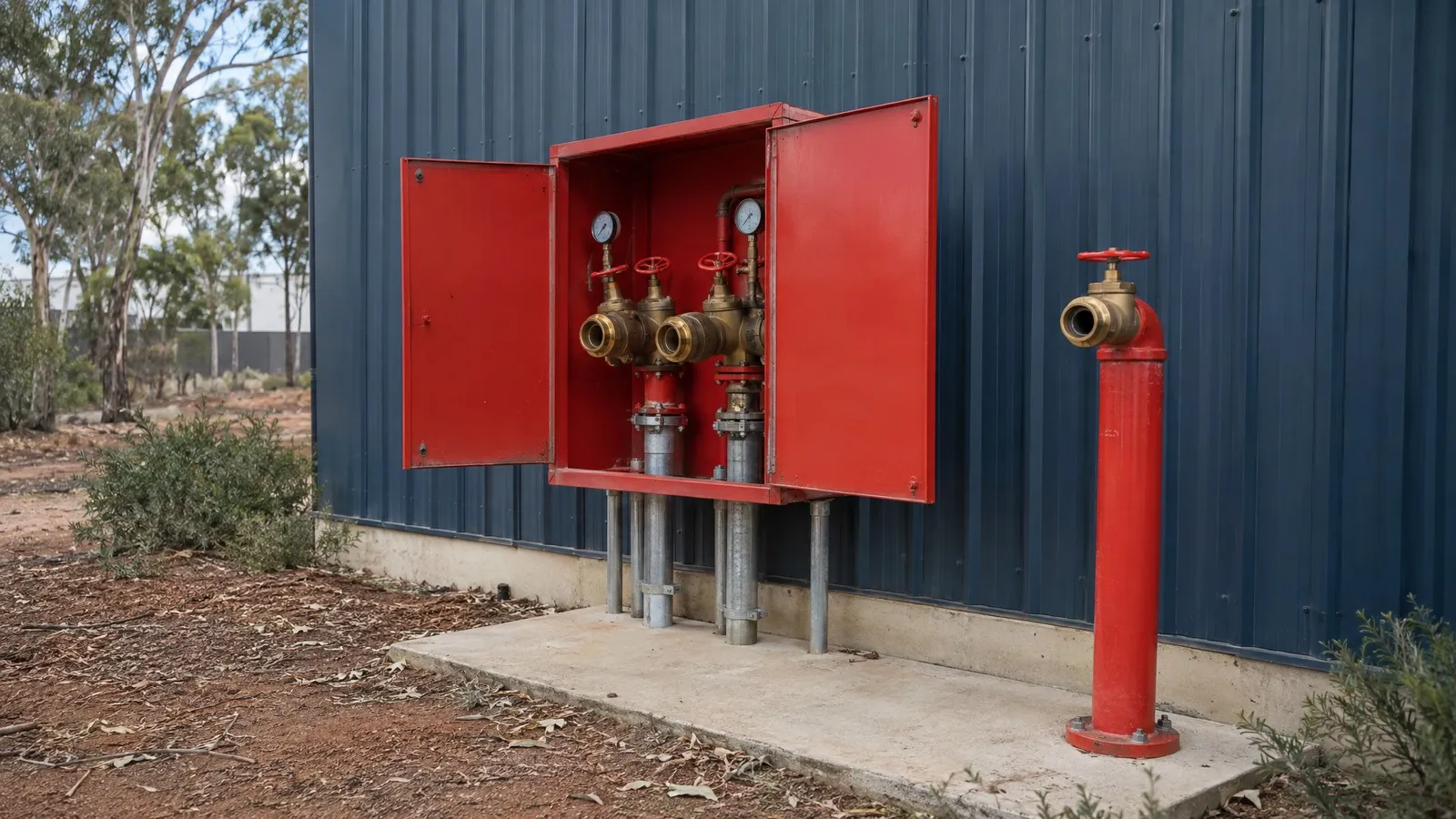
A booster assembly lets fire crews pump water into the building's hydrant system from their truck.
When a booster is required
Under AS 2419.1:2021, a booster is required where more than two feed hydrants are needed for coverage. The 2005 edition required one only where more than six external hydrants were needed. Queensland Fire Department guidance also calls for a booster where 10 L/s at 350 kPa can't be achieved, unassisted, at the most hydraulically disadvantaged hydrant.
Where a booster goes
- Preferred location. On the building façade, within 20 m of the main pedestrian entrance. A façade booster more than 20 m away needs a red strobe. A booster remote from the building goes at the vehicle entry to the site, visible from the entrance.
- Protection. A booster within 10 m of the building needs passive fire protection to AS 2419.1, so crews can work it during a fire.
- Clearances. The 2021 edition adds separation from electric vehicle chargers (more than 10 m) and gas vents (more than 3 m).
Block plans
Every booster needs a block plan, a site diagram of the hydrant system. Queensland Fire Department requires it to be etched, engraved or printed on metal or plastic, not laminated paper. It must be at least A3, fixed mechanically, and oriented to the site. Under the 2021 edition it also shows underground pipe lengths and sizes, hydrant ID numbers and the water supply's residual pressure.
Fire pumps
Where the town main can't deliver the required flow and pressure, the system needs a pump set, a water storage tank, or both. Pump sets are designed and installed to AS 2941. Industry guidance summarises the main triggers:
- Duty. Half-duty pumps deliver 5 L/s per outlet and full-duty pumps 10 L/s. Full duty is required above 50 m effective height.
- Height. Two pumps are required above 25 m effective height. Queensland Fire Department also requires fire brigade relay pumps in buildings over 50 m.
- Diesel. Diesel pumps need at least six hours of fuel and a pump room separate from the fire control centre.
In Toowoomba, a pump can't draw directly from council's main, so pumped systems usually include on-site storage.
Queensland Fire and Rescue: referral and documentation
For building work involving special fire services such as hydrants, sprinklers and boosters, QFR is a referral agency under the Planning Act 2016 and Planning Regulation 2017. QFR assesses the drawings and any fire engineering report, advises the building certifier on operational requirements, and may inspect the installed system.
Some simpler work is covered by QFR's Scope Reduction Initiative. For example, where a single street hydrant is the only special fire service, the applicant can use QFR's published response instead of a full referral. The documentation still goes to QFR when the certificate of occupancy is issued.
Flow and pressure evidence matters at certification. QFR expects a Form 72 (Queensland Development Code MP 6.1) showing that the hydrant has been tested for flow and pressure. Where a new hydrant is installed, a Form 71 is used instead.
Testing and maintenance under AS 1851 and Queensland law
Once installed, a hydrant system is a prescribed fire safety installation under the Building Fire Safety Regulation 2008. Maintenance must follow Queensland Development Code MP 6.1, which uses AS 1851-2012 for routine service. Industry guides summarise the AS 1851 schedule for hydrant systems:
| Interval | Hydrant system routine service (AS 1851-2012) |
|---|---|
| Six-monthly | Inspect valves, outlets, booster assembly, signage, block plan and access |
| Yearly | Flow and pressure test at the most hydraulically disadvantaged hydrant |
| Five-yearly | Fire brigade booster flow test and hydrostatic test; replace seats and washers as required |
| Monthly | Pump sets supplying the hydrant system are run-tested under their own section of AS 1851 |
The occupier carries the legal duties:
- Have the system maintained by an appropriately qualified person and tested at MP 6.1 intervals.
- Have any defect fixed within one month.
- Keep a maintenance record signed by whoever does the work.
- Prepare an occupier statement each year, keep it for two years, and give a copy to the fire commissioner within 10 business days.
A maintainer who finds a critical defect must give a critical defect notice within 24 hours.
Who can design, install and certify hydrant systems?
Since 1 May 2021, hydrant and hose reel work has been licensed by the QBCC under the water-based fire system stream. It has separate licence classes for:
- install and maintain
- design
- inspect and test
- certify.
Check each contractor's classes against the work they will do on the QBCC licence register. Burke Industries holds QBCC licence 48707, which includes Fire Protection – Water-Based Fire System – Install and Maintain for commercial and industrial buildings. On hydrant projects we install and maintain systems designed and certified by appropriately licensed professionals.
Checklist for a compliant hydrant system
- Confirm the NCC trigger: total floor area over 500 m² and a fire station within 50 km.
- Get a three-point pressure and flow test from council, plus the network's modelled residual pressure.
- Have a licensed designer set coverage, outlets flowing, and the need for a booster, pump or tank under AS 2419.1:2021.
- Locate the booster, hardstand and block plan to suit QFR requirements, and allow for QFR referral.
- Install with a QBCC-licensed contractor, then flow test and commission. Provide Form 71 or Form 72 to the certifier.
- Set up AS 1851 routine service, maintenance records and the annual occupier statement.
For installation, upgrades and maintenance on commercial and government buildings, see our fire hydrant installation service in Toowoomba.
Frequently asked questions
When does a commercial building in Queensland need fire hydrants?
Under NCC 2022 clause E1D2, when the building's total floor area is more than 500 m² and a fire brigade station with suitable equipment is within 50 km by road. The system must be designed and installed to AS 2419.1:2021.
What is the coverage distance for fire hydrants under AS 2419.1:2021?
Each external feed hydrant must be within 20 m of a fire truck hardstand, with every part of the building it protects within 70 m of that truck. Internal hydrants must reach every part of the floor within 40 m, or 45 m where NCC travel distances are met.
What flow rate does a fire hydrant need?
At least 10 L/s from each required outlet. Unassisted feed hydrants need 10 L/s at 200 kPa. Attack hydrants need 10 L/s at 350 kPa unassisted, or 700 kPa when boosted by the fire brigade. The number of outlets flowing at once depends on the building.
When is a fire brigade booster required?
Under AS 2419.1:2021, when more than two feed hydrants are needed for coverage, down from more than six in the 2005 edition. Queensland Fire Department guidance also calls for one where 10 L/s at 350 kPa can't be achieved unassisted at the most disadvantaged hydrant.
What is a Form 72 in Queensland?
A Queensland Development Code MP 6.1 form recording flow and pressure test results for water-based fire safety installations. QFR expects it as evidence at building certification. Form 71 is used where a new hydrant is installed.
How often do fire hydrants need testing?
Under AS 1851-2012, hydrant systems are inspected six-monthly and flow tested yearly at the most disadvantaged hydrant. The booster flow and hydrostatic tests are done five-yearly. Queensland occupiers must keep maintenance records and fix defects within one month.
Can a booster pump connect directly to Toowoomba's water main?
No. Toowoomba Regional Council's Water Infrastructure Policy doesn't allow booster pumps to connect directly to its water network, so pumped hydrant systems usually include on-site storage. Council's pressure and flow tests for fire design must be three-point tests.
Get a site assessment for your fire hydrant system
Send us the building's class, floor area and drawings, and any existing flow test or maintenance records. We'll inspect the system or site and quote the installation, upgrade, flow testing or AS 1851 maintenance. Design and certification are done by a licensed designer and certifier.
Book a hydrant site assessmentOr see our commercial fire hydrant and hose reel installation in Toowoomba.
Sources
- NCC 2022 Volume One, Part E1. (E1D2 hydrants, E1D3 hose reels).
- Queensland Fire and Rescue: Scope Reduction Guidelines, version 07/2025. : street hydrant as feed hydrant, 20 m / 70 m, 10 m from the building, 10 m from high-voltage equipment and LPG, no street hydrant where a booster is used, Form 72 / Form 71, documentation at certificate of occupancy.
- Queensland Fire Department: NCC clause E1D16 guideline, version 03/2025. : attack hydrant 10 L/s at 350 kPa unassisted or 700 kPa boosted, feed 10 L/s at 200 kPa, booster where 350 kPa can't be achieved, booster within 10 m needs passive protection, relay pumps over 50 m.
- Queensland Fire Department: feed hydrant performance position statement, version 03/2025. : 10 L/s from each required feed hydrant outlet.
- Queensland Fire Department: block plans and location diagrams. : metal or plastic, A3 minimum, mechanically fixed, oriented to the site.
- Queensland Fire Department: fire hydrant and vehicle access guidelines, version 08/2026
- DFES (WA) info note quoting AS 2419.1:2021 clauses. : cl 3.5.3.2 (20 m / 70 m), cl 3.6.1 (40 m / 45 m), cl 4.2.7.1 (95th percentile demand).
- HTC Group: AS 2419.1:2021 changes. (secondary, 31 Jul 2023): external-only coverage levels, booster trigger of more than 2 feed hydrants, booster location and EV/gas clearances, block plan content, water supply duration and tank minimums.
- Standards Australia: NCC 2022 spotlight on fire hydrant installations. (scope exclusions).
- CCC Engineering: fire pump design memo. (secondary, Jul 2025): AS 2941, half and full duty, two pumps over 25 m, 6 hours of diesel; (144 kL); (Apr 2026, service intervals).
- Toowoomba Regional Council: Water Infrastructure Policy (2023). , cl 4.10.1: three-point tests only, unmetered separate fire services, check valve and metered bypass, certified service sizes, no direct booster pump connection.
- Toowoomba Regional Council: addendum to the Water Supply Code of Australia (2023). : 35 m minimum commercial and industrial pressure; under 16 m treated as pressure disadvantaged.
- Toowoomba Regional Council: backflow prevention
- Building Fire Safety Regulation 2008 (Qld). : ss 50, 53, 54, 55, 55A; .
- QBCC: water-based fire system licence classes. ; (Burke licence 48707, Install and Maintain, commercial and industrial).
- Burke Industries: existing Fire Hydrant Requirements page. (Form 72, the steps to meet requirements, and MP 6.1 maintenance were kept).