Short answer
In Queensland, you need a soil disposal permit from DETSI to remove contaminated soil from EMR or CLR land for treatment or disposal. There's no fee, decisions take 10 business days, and permits can't be amended. Landfilled contaminated earth attracts the general waste levy, $100 per tonne regional and $135 metro in 2026-27, unless exempted.
In this guide
This guide walks developers, consultants and council project teams through moving contaminated soil off a listed Queensland site. It covers when a permit is needed, what the application must contain, how the soil is classified, how the waste levy and its exemption work, and what Toowoomba's receiving facilities charge. It's based on DETSI's soil disposal permit guideline (ESR/2020/5353, v2.00, May 2026), the Environmental Protection Act 1994, the Environmental Protection Regulation 2019 and the Waste Reduction and Recycling Act 2011 and Regulation 2023.
When you need a soil disposal permit, and when you don't
| Situation | Permit needed? |
|---|---|
| Removing contaminated soil from land on the EMR or CLR to treat or dispose of it elsewhere | Yes |
| Bringing contaminated soil into Queensland from contaminated land interstate, to treat or dispose of it | Yes |
| Treating or managing contaminated soil on its site of origin | No |
| Removing soil that isn't contaminated with a hazardous contaminant from an EMR or CLR site | No, but you'll need the data to show it |
| Removing soil under a remediation notice | No |
| Contaminated soil from land that isn't on a register | Not automatically. The owner has a duty to notify DETSI, and the land should be recorded on the EMR, so treat this as a warning sign, not a loophole. |
Moving soil from listed land without a permit is an offence. The permit provisions are the former ss 424–425 of the Environmental Protection Act, kept in force by s 739, with a maximum penalty of 100 penalty units each for moving soil without a permit or breaching its conditions.
Step by step: getting a soil disposal permit
Step 1: Confirm the listing
Search the EMR and CLR for each lot. In 2026-27 it costs $61.05 per lot online, and results usually arrive immediately. The application asks for the EMR or CLR site ID, the lot on plan, GPS coordinates and a current certificate of title.
Step 2: Show why the soil has to go off site
DETSI's permit page calls on-site remediation best practice, and landfill is the least preferred option in the National Environment Protection Measure (NEPM) remediation hierarchy. The application must describe the remediation options already considered and explain why off-site removal is the only option left.
Step 3: Sample and characterise the soil
This is where most applications succeed or fail. The guideline and form require:
- sampling locations, depths, methods, preservation and quality assurance, with a scaled plan
- results for each sample for all hazardous contaminants. “An averaged result for the site will not be sufficient.”
- chain-of-custody records and NATA-accredited certificates of analysis
- leachate results (TCLP or unbuffered ASLP)
- a site history covering all chemicals of potential concern
- recent, current data.
Dilution, such as mixing contaminated soil with clean soil to bring results down, is “not an acceptable remediation strategy.” The guideline points to the NEPM, EPA Victoria's IWRG702 (2024) and, for PFAS, the PFAS National Environmental Management Plan 3.0 as reference frameworks. Your environmental consultant normally prepares this part.
Step 4: Calculate the volume properly
Give the volume in both cubic metres and tonnes, as the bulk or loose size after excavation, not the bank volume. The form asks for the bulking factor and how you calculated it. Under-estimating is costly. The permit sets a maximum volume and can't be amended, so exceeding it means a new application.
Step 5: Get a receiving facility acceptance letter
Each receiving facility (up to two) must give written acceptance stating:
- the lot on plan of the source site and of the facility
- the facility's environmental authority number
- a statement that the facility complies with its environmental authority
- the total volume it will accept
- the disposal method (double lined, lined, unlined, treatment or day cover)
- the lab results or report it relied on.
Step 6: Lodge the application
Use form ESR/2015/1832 (v5.01) and email it to DETSI. The applicant becomes the permit holder and can nominate a consultant as the contact. If the applicant isn't the landowner, the owner's written consent is needed. Timing and conditions:
- Fee. There's no application fee.
- Timing. DETSI decides properly submitted applications within 10 business days of validation and issues the permit within a further 8 business days.
- No review. The decision isn't an “original decision”, so there are no formal review or appeal rights.
- Conditions. The permit fixes the maximum volume, the source parcel, the destination, and start and expiry dates. The maximum approval period is one year from the start date.
Step 7: Apply for a levy exemption, if eligible
If the soil may qualify for a waste levy exemption (see below), apply in parallel. You can't move contaminated earth and claim the exemption without a soil disposal permit, and the exemption isn't retrospective.
Step 8: Excavate, transport and dispose within the permit
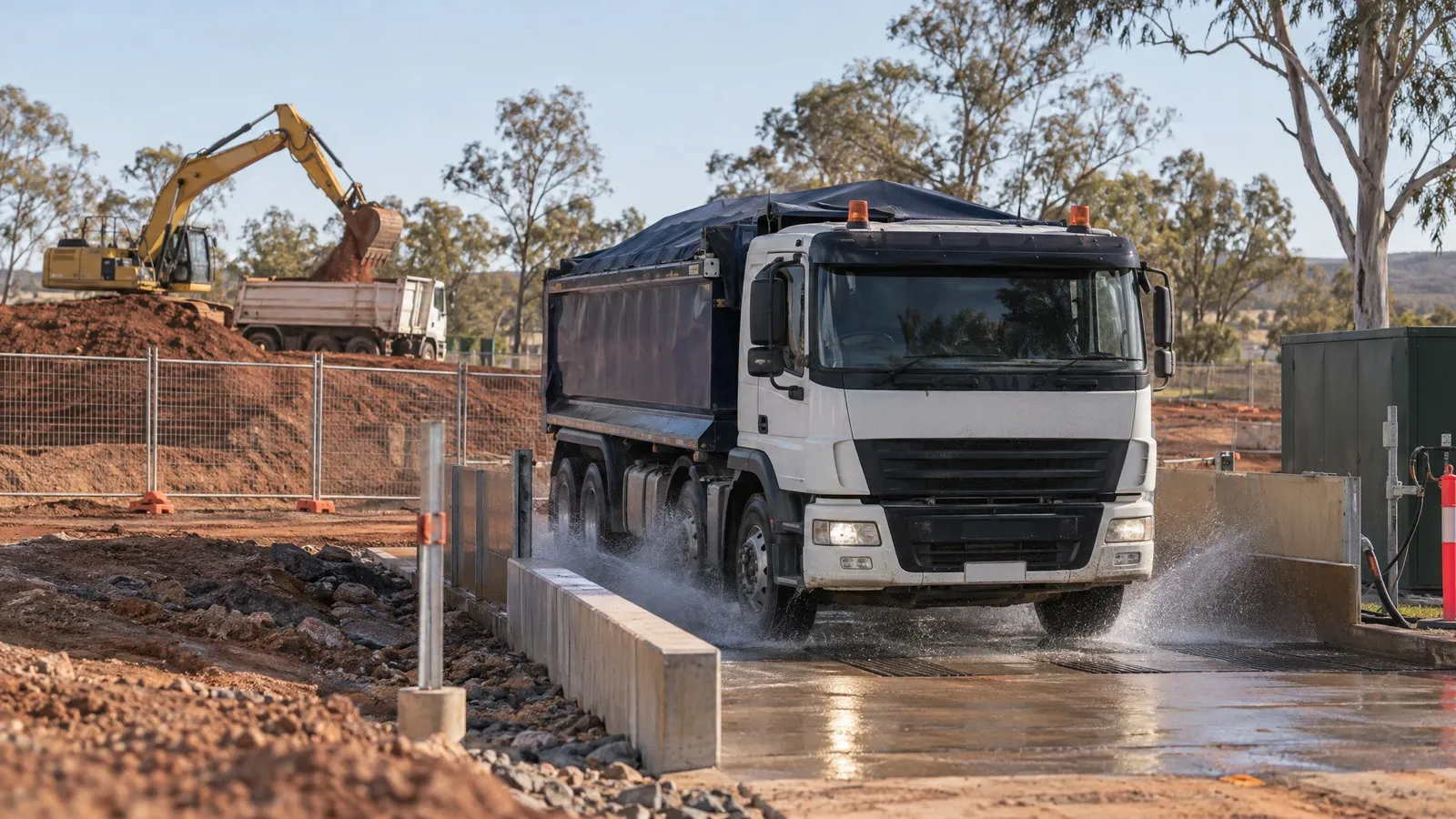
Keep to the permitted volume, destination and dates. Give a copy of the permit to everyone involved, and keep the facility's acceptance receipts. DETSI can require the quantities shown on those receipts if it suspects non-compliance. The guideline also advises licensed transporters and covered loads.
Step 9: Validate and update the register
Once the soil is out, the consultant's validation sampling confirms the remaining soil meets the criteria. An auditor-certified validation report with a site suitability statement is how the land comes off the register or has its listing amended.
Is contaminated soil regulated waste?
Under the Environmental Protection Regulation 2019, waste of a type listed in Schedule 9, Part 3, Division 1 is not regulated waste (s 42(3)). That list includes “contaminated soil from land recorded in the environmental management register or contaminated land register.” So contaminated soil from listed land is not regulated waste, whether or not a permit is held. The soil disposal permit is the main control.
Contaminated soil from land not on a register, including soil brought from interstate, may still be regulated waste. That depends on what it contains or how it tests against the Regulation's thresholds. Regulated waste is classed as Category 1 or Category 2, either by default category or by testing (DETSI guideline ESR/2019/4749). Test results are valid for no more than three months.
Waste tracking and transport
Waste tracking under the Environmental Protection Regulation applies to regulated waste of a type listed in Schedule 11 (trackable waste). Because soil from EMR or CLR land isn't regulated waste, the tracking rules and the regulated waste transport licence (ERA 57) aren't triggered for it. That's our reading of the Regulation; DETSI doesn't say it directly. Where contaminated soil is regulated waste:
- it must be tracked
- a generator must not hand it over for transport for a fee, or in loads over 250 kg, to anyone without an environmental authority.
Either way, use a licensed transporter and covered loads.
The Queensland waste levy
Contaminated earth from EMR or CLR land attracts the general waste levy rate when it goes to landfill. The 2026-27 rates per tonne are:
| Waste type | Metro zone | Regional zone |
|---|---|---|
| General waste, including earth contaminated with a hazardous contaminant from EMR or CLR land | $135 | $100 |
| Category 1 regulated waste | $215 | $198 |
| Category 2 regulated waste | $165 | $137 |
Which zone? From 1 July 2026, Toowoomba moved from the metro zone to the regional zone (Waste Reduction and Recycling (Variation of Waste Levy) Amendment Regulation 2026). Lockyer Valley, including Gatton, remains in the metro zone, so the higher rate applies there. Metro rates rise by $10 a year to 2029-30. Regional rates are indexed each year.
Clean earth is no longer listed as exempt waste under the Waste Reduction and Recycling Act, so it can attract the levy too unless another exemption applies.
The levy exemption for contaminated earth
Under the Waste Reduction and Recycling Act (s 28) and Regulation (s 10), DETSI must refuse an exemption unless one of these applies:
- the earth was contaminated before 1 January 1992
- it is landfill-cell waste for a significant community project
- it contains pre-1992 landfilled waste removed by or for a local government for remediation or a resource recovery or transfer facility.
DETSI must also refuse if the earth is contaminated solely with petroleum hydrocarbons, or only with contaminants that could reasonably be treated by bioremediation. The earth must not be mixed with clean earth, concrete or other material.
| Exemption detail | Requirement |
|---|---|
| Who applies | The person responsible for disposal: owner, developer, principal contractor or transporter. The approval isn't transferable. |
| How | Online, through the Queensland waste data system |
| Fee | $229.90 (amendment $60.15) |
| Decision | Within 28 days. No decision in that time is taken as a refusal. |
| Approval period | Up to 3 years. Not retrospective. Present the exemption number at the landfill. |
Receiving facilities in Toowoomba
Toowoomba Regional Council accepts contaminated soil that meets its environmental authority's acceptance criteria. Regulated waste goes to the Toowoomba Waste Management Centre at Cranley, which takes bulk waste only and isn't open to unstaffed drop-off. 2026/27 fees, including GST, are:
| Material | Up to 400 kg (per transaction) | Over 400 kg (per tonne) |
|---|---|---|
| Contaminated soil with a soil disposal permit | $115.60 | $289.00 |
| Contaminated soil with a permit and a levy exemption certificate | $56.20 | $140.50 |
| PFAS-contaminated soil (commercial) | – | $453.20 |
| Regulated waste, Category 1 | $181.30 | $453.20 |
| Regulated waste, Category 2 | $140.90 | $352.40 |
| Clean earth (cover material, by arrangement) | $59.40 | $148.50 |
Other charges and conditions:
- an administration fee of $48.40 per transaction for contaminated soil or regulated waste
- prior approval and evidence of compliance for bulk loads over 5 m³
- a special burial charge for dusty or odorous soils
- a 100% surcharge on waste from outside the council area.
Soils that don't meet the acceptance criteria aren't accepted at any council facility.
The levy exemption matters at the gate. For 500 tonnes of permitted soil, council's gate fee is about $144,500 without an exemption and about $70,250 with one. That's before excavation, transport and the $48.40 per-transaction administration fee.
Where Burke Industries fits
Your consultant designs the sampling, classifies the soil and writes the permit application, and the auditor certifies the outcome. We do the physical work to that plan:
- excavating and segregating contaminated from clean soil, so you don't pay disposal rates on clean material
- loading and transporting within the permit's volume and destination
- keeping receiving receipts for your records
- holding excavations open until validation sampling is complete.
Public contract records show Burke delivering contaminated soil removal for QBuild at Drillham State School ($327,250, December 2022) and in Dalby ($357,646, stage 1, October 2023).
Checklist
- Confirm the EMR or CLR listing for every lot.
- Document why on-site treatment isn't practicable.
- Get per-sample results, leachate results, NATA certificates, chain of custody and a site history.
- Calculate the loose volume, with the bulking factor, in m³ and tonnes, with a margin.
- Get written acceptance from up to two receiving facilities.
- Lodge form ESR/2015/1832 with the owner's consent, and allow 10 plus 8 business days.
- Apply for a levy exemption in parallel if the contamination predates 1992 and isn't solely hydrocarbons.
- Remove only within the permitted volume, destination and dates, and keep every receipt.
- Validate, then submit the validation report to amend or remove the listing.
Ready to schedule the excavation? See our contaminated soil removal service in Toowoomba.
Frequently asked questions
When do I need a contaminated soil disposal permit in Queensland?
When you remove contaminated soil from land on the EMR or CLR to treat or dispose of it elsewhere, or bring contaminated soil into Queensland from interstate. You don't need one to treat or manage the soil on its site of origin.
How much does a soil disposal permit cost and how long does it take?
There's no application fee. DETSI decides properly submitted applications within 10 business days of validation and issues the permit within a further 8 business days. The maximum approval period is one year from the start date.
Can a soil disposal permit be amended?
No. The permit fixes the maximum volume, source, destination and dates. If you need more volume or more time, you need a new permit. Calculate the loose, post-excavation volume with a bulking factor and allow a margin.
Is contaminated soil regulated waste in Queensland?
Contaminated soil from land on the EMR or CLR is excluded from regulated waste under Schedule 9 of the Environmental Protection Regulation 2019. Contaminated soil from unlisted land, or from interstate, may be regulated waste depending on what it contains.
What waste levy applies to contaminated soil?
Earth contaminated with a hazardous contaminant from EMR or CLR land attracts the general levy rate: $100 per tonne in the regional zone and $135 in the metro zone in 2026-27. Toowoomba is regional from 1 July 2026, and Lockyer Valley is metro.
Can I get a waste levy exemption for contaminated soil?
Only in limited cases, mainly where the earth was contaminated before 1 January 1992. It's refused for soil contaminated solely with petroleum hydrocarbons or treatable by bioremediation. Apply online for $229.90; DETSI decides within 28 days, and you also need a soil disposal permit.
Does Toowoomba Regional Council accept contaminated soil?
Yes, if it meets council's environmental authority acceptance criteria. In 2026/27, permitted contaminated soil costs $289 per tonne over 400 kg, or $140.50 with a levy exemption certificate. Bulk loads over 5 m³ need prior approval.
Get a site assessment for your soil removal
Send us the soil disposal permit or application, the consultant's sampling plan and volumes, and the receiving facility. We'll inspect the site and quote excavation, segregation, transport within the permit and support for validation, so the clean soil stays on site.
Book a soil removal site assessmentOr see our contaminated soil removal in Toowoomba and the Darling Downs.
Sources
- Queensland Government: soil disposal permit. (reviewed 29 May 2026): no fee, 10 business days, cannot be amended, on-site remediation best practice.
- DETSI: Soil disposal permit guideline ESR/2020/5353 v2.00 (22 May 2026). : when needed and not needed, application contents, per-sample data, TCLP and ASLP, dilution not acceptable, acceptance letter contents, decision in 10 plus 8 business days, no review rights, permit conditions, reference to NEPM, EPA Victoria IWRG702 (2024) and PFAS NEMP 3.0.
- DETSI: Application form ESR/2015/1832 v5.01. : loose volume and bulking factor, maximum one-year approval period, up to two facilities.
- Environmental Protection Act 1994 (Qld). : s 739 continuing former ss 424–425 (100 penalty units each).
- Environmental Protection Regulation 2019. : s 42(3) and Sch 9 Pt 3 Div 1 item 19 (EMR and CLR soil is not regulated waste); s 71 and Sch 11 (trackable waste); s 96 (transport to an EA holder); Sch 2 s 57 (ERA 57).
- Business Queensland: regulated waste classification. and (test results valid for 3 months).
- Queensland Government: levy rates. (updated 26 Jun 2026); Waste Reduction and Recycling Regulation 2023, Sch 1 (rates) and Sch 2 (levy zones), as amended by the Waste Reduction and Recycling (Variation of Waste Levy) Amendment Regulation 2026 (SL 2026 No. 87): Toowoomba regional from 1 Jul 2026, Lockyer Valley metro. Available on .
- DETSI guideline ESR/2024/6780. : WRR Act s 28 and Regulation s 10 exemption criteria, QWDS lodgement, $229.90 fee, 28 days, 3-year maximum, not retrospective, permit needed.
- Toowoomba Regional Council: 2026/27 register of fees and charges. : contaminated soil fees (items 14–16), regulated waste, clean earth, PFAS soil, Appendix A acceptance conditions, Toowoomba Waste Management Centre, out-of-area surcharge.
- . Burke contaminated soil contracts: Queensland open data contract disclosures: Drillham SS ($327,250, Dec 2022); Dalby W/O 19375183 stage 1 ($357,646, Oct 2023).